
My innate talent. Is it possible to find it out? So many words were written about human talents. But what is talent? Some people say, that talents can be taught. But let’s consider talent as a combination of stable predetermined theoretical signs and phenomena in human thinking, which can be noticed by logical way of research. This is the way we used for creation a table of talents for each ITT (innate type of thinking), taken into account emotions and other characteristics.
My innate talent table with description
DLTT, ASCT etc. are the innate personality types we call ITT. Does my innate talent depends on my ITT? The answer is yes. Each personality type has its own innate talents. In fact, it helps such people to learn faster and complete certain tasks much easier and more productively.
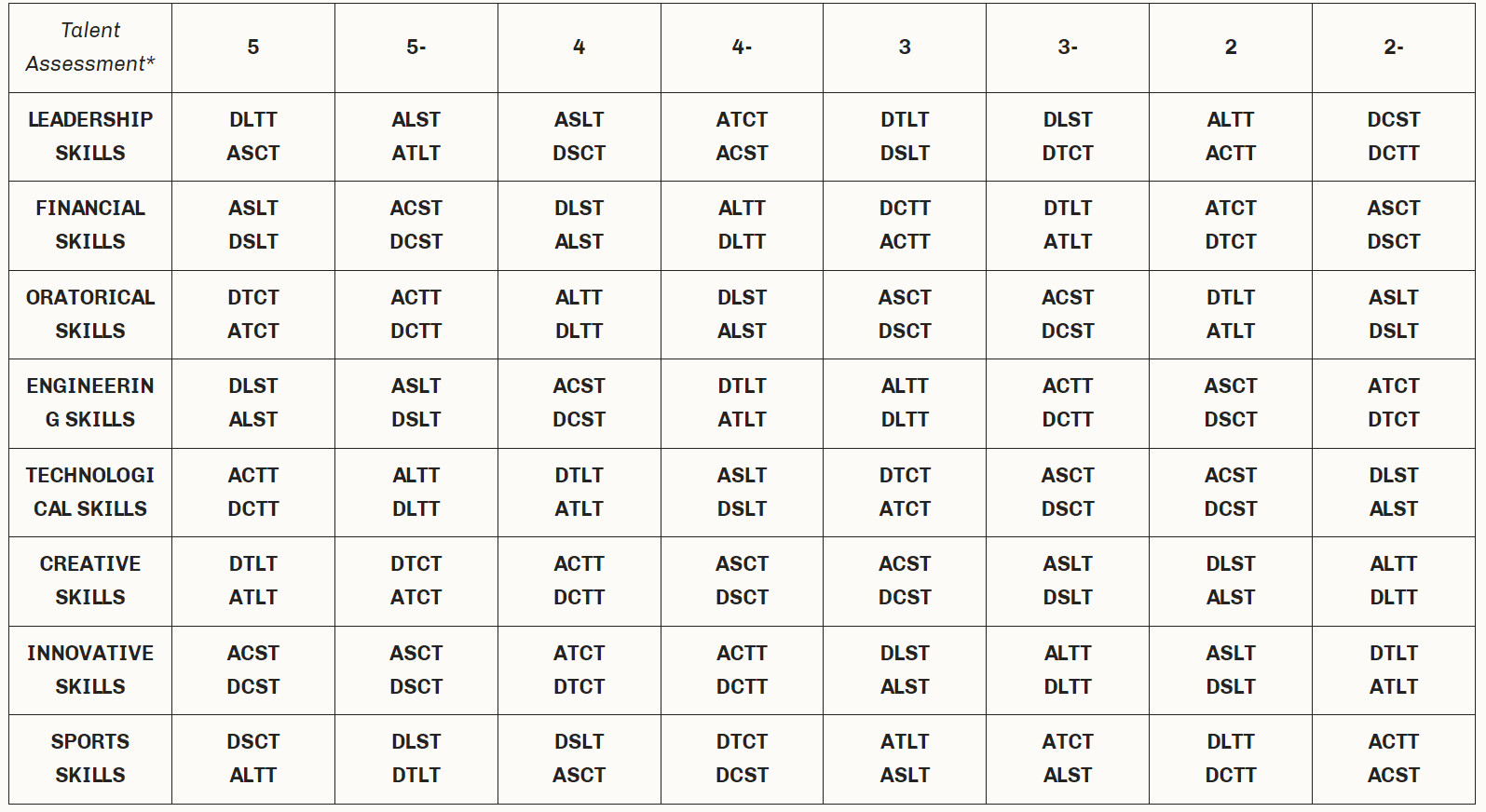
*Talent Assessment shows the innate talent. It does not reflect the quality and the result of work. It shows only talent and emotional pressure when people do such tasks. 5 is the highest mark. Such people can have different jobs and hobbies simultaneously without loosing their innate talent. For example, if I have mark 5 that means that my innate talent in that field is the highest, stable and better than 4 etc.
The mark between 5 and 4 means that such person can easily complete such tasks without nerves or emotions.
People who have mark between 4 and 3 sometimes can be lazy about those tasks but still can do many of them. Those people who have between 3 and 2 mark do such tasks with difficulties and they can feel negative emotions or anger in the process.
Those who have mark 2 and lower usually need help to complete with such tasks and may have stress.
We also noticed, that people who have the worst mark may not feel any emotions at all and they calmly aware with humility that they have no talents to do such tasks.
But we also noticed such anomal thing, that people who have mark 2 and lower may have one very strong talent in a narrow work area regarding their skill in that field. This talent is not related to their innate talents, it is related to their experience and commitment to their job task. For example, DCTT has very low Leadership and Sports Skill. But if such person devotes his whole life to learn how to be a leader or athlete in narrow area of work, they can become very experienced and excellent professionals. But the main point here is that this people should always do their tasks and should be obsessed with their work, not being distracted by other things.
Please also note, that there is no need to calculate the points of each ITT and their talent in order to know which type of ITT is more smart or the best. This is due to fact, that you should take into account that some positions are more useful objectively for mankind. For example, “ENGINEERING SKILLS” will always be more useful for all people than “ORATORICAL”
Short typological explanation of skills and talents
Such explanation list is very brief but precise and well structured for your better understanding
LEADERSHIP SKILLS
(management + hierarchy + authority) are the skills for such positions as: politician, commander, director, manager
FINANCIAL SKILLS
(calculation + logic + control) are for such positions as: analyst, financier, accountant, economist, appraiser, warehouse manager, businessman, mathematician
ORATORICAL SKILLS
(meaning + constructive + information) are the skills for such positions as: author, lawyer, judge, television host, publisher, musician, scientist, writer, orator, journalist, teacher, singer
ENGINEERING SKILLS
(safety + responsibility + nuances) are the skills for such positions as: builder, engineer, machine operator, driver, carpenter, architect, furniture maker, electrician, stonemason
TECHNOLOGICAL SKILLS
(development + accessibility + connections) are the skills for such positions as: technologist, software developer, programmer, repair technician, computer operator, IT professional
CREATIVE SKILLS
(quality + attention + idea) are the skills for such positions as: painter, photographer, sculptor, seamstress, fisherman, sniper, hunter, surgeon, gynecologist
INNOVATIVE SKILLS
(taste + beauty + assessment) are the skills for such positions as: designer, interior designer, cook, confectioner, fashion designer, hairdresser, manicurist
SPORTS SKILLS
(physical training + health + usefulness) are the skills for such positions as: athlete, physical education teacher, delivery courier, psychologist, guide, soldier
 World Typology