

Is there a division between “destructive” and “developmental” people by their qualities? Who is destructive? And who is developmental? People have always tried to divide other people based on their conclusions and facts.
Obviously, subjectively for you, the bad people are always those you don’t like or those who do or have done something bad to you. Therefore, it is logical that there are two subjective paths in your critical interactions with other people. The first path is those whom you dislike and whom you are willing to “teach a lesson”. And the second path is those who don’t like you and who are willing to teach you a lesson.
It is for these relations the relations of 8 groups of people, specified here, and also interpersonal relations, specified here, are responsible. Both of these relationships will be considered subjective relationships that directly affect you.
But what about the objective innate human qualities?
What is that? These qualities don’t affect your personal relationships, but do affect what builds or breaks in the world. Instead of personal relationships and contact, people with these objective qualities can only show their approval or disagreement with certain statements or actions of the other party. And as you have already realized, this is precisely the topic of this article.
In our book “Two innate types of thinking: developmental and destructive” we pointed out that in the world there are people who quite clearly and consistently like to destroy it and those people who like to develop and build this world, improving it.
All actions of “invaders” (destructive) are always aimed at destroying something and they get stable pleasure and interest from it. At the same time, people of “developmental” nature never enjoy chaos and destruction. The nature of “developmental” people is formed in such a way that they realize only the good and they try to see this good in everything stable and generate it with their thoughts and deeds.
Where does this conclusion come from? The fact is that a great deal of work has been done over several years and stable facts taken from nature and environment have been studied. These facts were logically linked to the typology we came at, created and refined.
Following the logic, the not obvious fact that there are 16 innate developmental qualities and 16 destructive qualities in nature came out.
You will ask: “Why exactly thirty-two qualities and not twenty or thirty-five?”. To list exactly how many qualities there are in one person, one must first have the ability and skills to see a certain image (type) in a person.
A certain image in each person reminds us of a puzzle picture. But first we need to see the complete picture on the basis of ITT (Innate Type of Thinking) and then break it down into puzzles. We take into account the fact that in nature there is the opposite of ITT as a law of nature in everything. And we also take into account the fact that all qualities exist in reality and leave their traces in reality.
As a result, having broken two opposite ITTs, we could see coincidences of figures and counted that in the first image. In the second image there are also sixteen qualities. Summing these qualities, we obtained thirty-two qualities for all people.
Another coincidence with this figure we saw in “Compact socionics” (“Практичная соционика”), which we created and have been working with for many years. In socionics, the foundations are sixteen types of people and sixteen types of relationships. By themselves, these matches make logical sense and have a pattern, and after studying how the tools and thinking of each type work, we realized that the matches with the numbers of qualities are not coincidental.
Later, we decided to spend another two years to see if there were any other hidden qualities in people in reality that might fit a certain image of the two types of people. In the end, our attempts to discover new and peculiar qualities that fit these images were not successful.
But we only realized one thing, that some meanings of words have similar characteristic and decided not to apply synonyms to name one quality that performs one function. For example, “lie” and “cunning” – the meaning of these two words have a slightly different process and meaning, but they equally have the same task – to present information in a distorted or hidden form.
Therefore, in the end, there are exactly thirty-two qualities that we discovered during the long period of our labor-intensive work. These qualities are objective, stable and inherited.
In total, let us list such 16 “invasive” (destructive) qualities:
1. Destruction – the pleasure of killing others in the shortest amount of time. It does not matter whether the victim is human or animal. This also includes crushing inanimate objects, as well as an increased tendency to suicide.
2. Torture – pleasure in inflicting slow physical mutilation that results in the face pain and moral suffering of another person or oneself.
3. Theft – the stable temptation to appropriate something of another person’s property.
4. Blackmail – the temptation to frighten and dictate terms to others for personal gain.
5. Pressure – rude behavior and harsh response to others if they do not follow his design and plan.
6. Defectivity – a steady unwillingness to put forth maximum effort to produce a quality work product or service, a fun to observe something defective.
7. Chaos – pleasure in seeing objective chaos happening around and contributing to the creation of such a situation.
8. Ridicule – a stable desire to tease and ridicule others in order to cause anger, tears, or resentment.
9. Bribery – the temptation to demand something from others for some favor or assistance in order to provide some quick personal solution to a situation, bypassing the established order.
10. Hierarchy – the desire to obey any demands of those higher in status without question.
11. Laziness – stable fear of work and desire to spend more time in rest than to help others and to show initiative in labor.
12. Greed – stable unwillingness to share anything with others, desire to accumulate anything in large quantities without any sense, exceeding the size of the real need.
13. Intrusiveness – temptation to pester others steadily and carefully for no matter what purpose, increased dependence on any hobbies and addiction.
14. Lie – a stable desire to trick and deceive others and oneself with or without some purpose.
15. Spirituality – a desire to close one’s eyes to negative events and actions of others, fixating on one’s inner world, ignoring what is happening in the environment, and mixing this act with religion.
16. Family – strong stable attachment and frankness to family members instead of other people.
On the counterbalance of these qualities, there are in nature such 16 “developmental” qualities:
1. Responsibility to any objects – a person’s desire to protect the life of another person or animal and unwillingness to break and damage even inanimate objects.
2. Empathy for people and animals – a feeling of pity for people and animals, readiness to come to their aid in case of trouble or apparent need.
3. Technology – the desire to learn and create new technologies in order to improve the quality of life and its conditions.
4. Science – an independent desire of a person to learn something new and to study, using observations and experience, other people’s books, studies at school or institute.
5. Criticism – a stable desire to point out others’ and one’s own mistakes, minuses and shortcomings in something, in order to correct them.
6. Quality – the desire to try to do one’s job with a lot of effort and attention in order to get the most improved product or service.
7. Order – a stable desire to organize something so that every phenomenon or thing corresponds to one place and is always there.
8. Control – a stable desire to observe others and check other people, their words and actions, for the purpose of further self-protection.
9. Cleanliness – a desire to steadily maintain cleanliness in the house and outdoors by removing trash and dirt, a desire to wash frequently and to emphasize keeping others clean.
10. Equality – stable desire for equality and unwillingness to listen to the orders of people higher in the hierarchy, if such orders contradict the values of a person and his needs.
11. Work – the desire to constantly do something physically in order to get a real product at the output or result of labor.
12. Generosity – a stable desire to share something with other people who are not only in the family circle.
13. Modesty – a stable sense of shame and conscience, as well as reluctance to ask anything from others, unless a person is in a critical life situation from his point of view.
14. Honesty – a stable desire to tell others the truth in everything and to tell aloud one’s real thoughts.
15. Progress – the desire to develop and get even more result of labor in the shortest possible time.
16. Friendship – a stable desire to communicate openly, kindly and trustingly, to meet and keep in touch with other people who are not in the family circle.
All these qualities listed above do not mix with each other. What do we mean here? All people of the “invasive” innate groups always have all 15 “invasive” qualities and only one any stable “developmental” quality, which he or she acquires from childhood, for reasons not yet quite clear to us. He or she will have in total 16 qualities (15+1).
Similarly, a person belonging to the “developmental” innate group has inside stably all 15 “developmental” qualities and some one “invasive” quality that has been stably present in him or her since early childhood. And these qualities do not change in person. Just remember this as a rule of thumb.
Studying these qualities, their meaning and following the natural law of opposites, we divided them into practical and theoretical. Practical – qualities that are more in practice in reality than they are in a person’s thinking. Theoretical – qualities that are more in the head and less manifest themselves in practice. On this basis the table was built:


As you can see above, the practical “invasive” quality “destruction” has an antonym in the form of a “developmental” theoretical quality called “responsibility to any object”. Similarly, the opposite of the quality “greed” is the quality “generosity”.
Proceeding from this it becomes clear that if in the person from “developmental” group all 15 “developmental” qualities and one “invasive” quality “lie” always work, then in such person “honesty” will not work.
Similarly, if a “developing” person has the quality “pressure”, then opposite to it in the column of the table there is the quality “criticism”, that automatically says that criticism will not work in such a person. But there is one more important nuance.
Such opposite qualities have misunderstanding and do not support each other. But before we can confidently build a confrontation between these opposing qualities, we need to consider the fact whether they are “theoretical” or “practical”. Why? This is because both qualities have different effects in reality, for one quality is theoretical and the other is practical. They will always have different levels of power and effect on the environment. Therefore, they cannot communicate and compete with each other in the process of contact. Therefore, their relationship remains at the level of misunderstanding and hostility, which brings no result to either of them.
That means that for the mutual relations of such qualities in reality it is necessary to build the separate tables on pairs “practical-practical” opposite qualities and “theoretical-theoretical”.
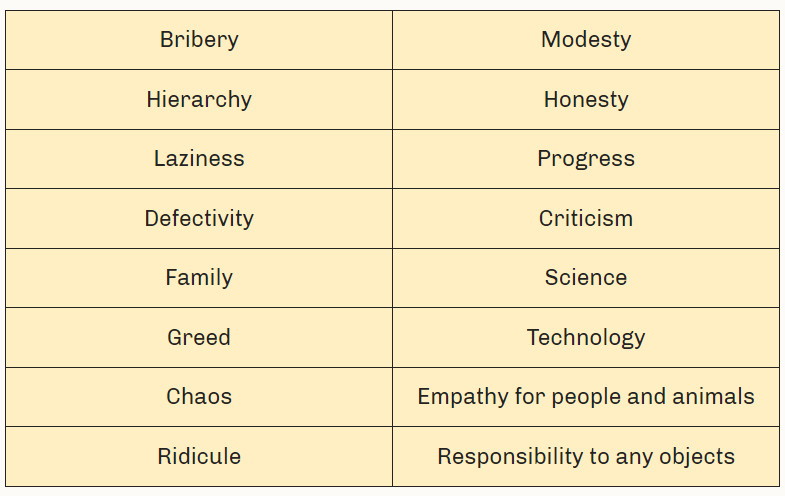
For example, the quality “hierarchy” is a theoretical “invasive” quality. Hence the opponent of this quality in reality will be some “developmental” and also theoretical (not practical) quality, which is opposite to “hierarchy” in the list. And that quality is “honesty”.
Here is a table of “opposing” theoretical qualities:
Here is a table of “opposing” practical qualities:
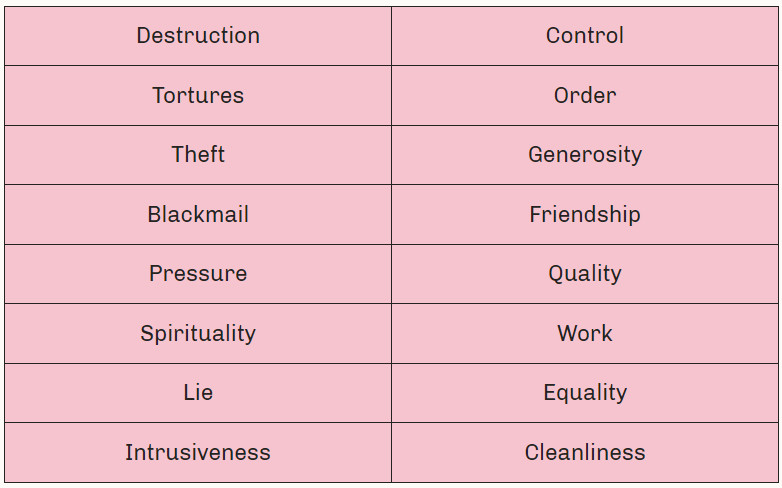
The so-called “opposing” qualities are actually stronger where there is a clearly defined imbalance in society that creates a temptation for the opposite quality to work. What is meant here? If any country in the world is objectively strongly dominated by some quality, for example “equality” (practical developmental quality), then people with the opposite practical destructive quality will interfere in the affairs of this country in order to restore or create balance there.
Because objectively a country with strong “equality” among people will look boring, monotonous, like an “incubator” and steadily causes temptation to change something for people who have the quality “lie” stably working. This is done by nature to disrupt the off the scale habitual lifestyle of “equality”. In doing so, it will be easier for a person with “lie” to stand out from such people. We hope the example is clear. This is what happens in the confrontation of other qualities as well.
But the main paradox here is that such opposing qualities unconsciously yield to each other in order to create a balance, so there is no war between them. It is simply like a “tug-of-war” in search of meaning and benefit, where both sides will eventually get theirs at different times.
It is also important to know and remember that all the qualities listed above in our article are not psychological and do not belong to psychology, as it is quite clear they are innate and it is impossible to change them in a person. It is typology and logic that has clearly defined this.
Therefore, psychology is not able to influence these qualities in any way in order to eradicate them in a person. Following this, the conclusion is that psychologists must first adjust to these above-described qualities and take them into account before trying to help a person in any way. Because, to repeat, the true goal of real psychology is to change only what can be changed. And these qualities are not on the list of things that can be changed without harming the person and his psyche.
Therefore, every psychologist must remember that attempts to influence these qualities or attempts to change them in a person may lead to bad consequences for the person himself and possibly for his environment. And of course, the goal of a real psychologist is to help a person with his problems, not to aggravate them.
Now, what else we would like to add in conclusion to this information?
It is that practical destructive qualities are more dangerous and harmful for the environment than theoretical destructive qualities. And the worst of the “invasive” practical qualities is destruction (murder). This is clear enough. Therefore, it is dangerous to apply strong control inside and outside a country, because it will increase the level of destruction of such a country both from inside and outside. Because the quality of “control” attracts the quality of “destruction” (murder) automatically. By control is meant the control of the system over a person, freedom of his speech, freedom of movement, his health, job, bank accounts, telephone and other things.
But lastly we will repeat that the more important information for your study is the 8 innate groups of people, the relations of these groups, temperament, category, nature and so on. Because these things have a much greater impact on your subjective personal relationships with other people in reality than the objective topic of this article.
And also a reminder that all information on this website is copyrighted and the information about “destructive» and «developmental» qualities was first published by us in 2020 and is now updated here with a little new observation. All information is for non-commercial use and study only. And we are very happy that it is now available to you and for your learning.
 World Typology